

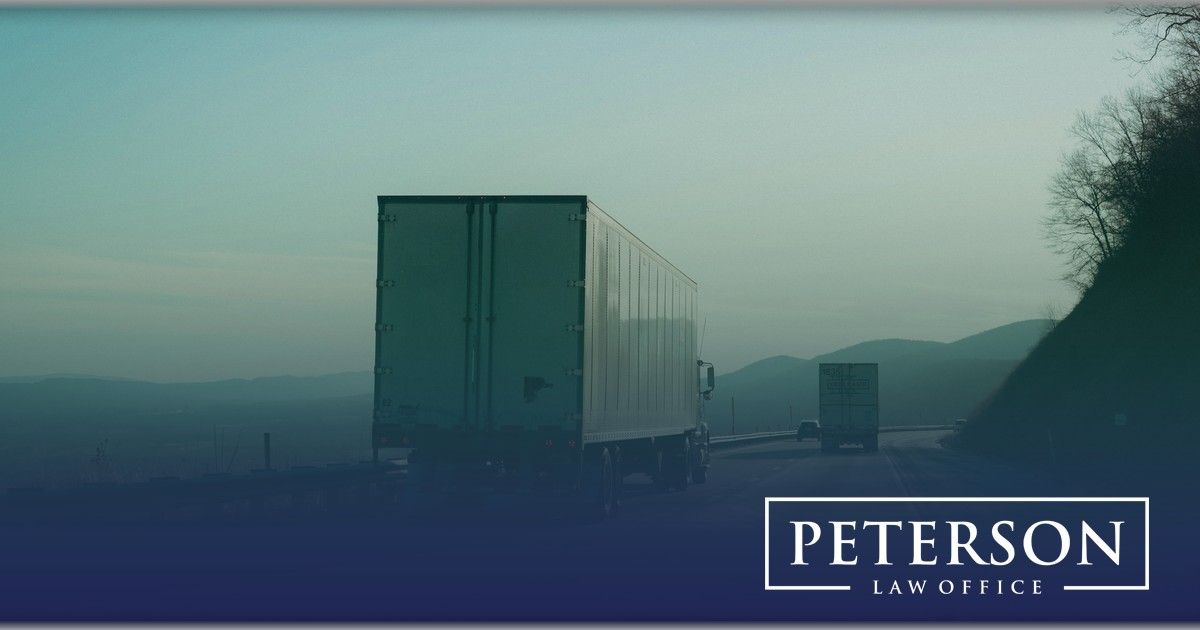
A semi-truck leaving Detroit for Atlanta and a semi-truck leaving Norfolk for St. Louis have exactly one thing in common. Both of them come through Lexington.
For 6.3 miles on the north side of the city, I-75 and I-64 share the same pavement, and every truck on either route has to merge in and sort itself out before the split at exit 118. You drive that stretch to work. You drive it to the Horse Park with the kids in the back seat. When it goes wrong, it’s your car against 80,000 pounds. If a crash on this corridor has already changed your life, here is what you will need to know about truck accidents in Lexington.
Two Interstates, One Piece of Pavement
I-75 carries the north-south freight between the Midwest and the Southeast. I-64 carries the east-west loads between the Ohio Valley and the Atlantic ports. Lexington is where they cross, and the Kentucky State Police numbers show what that costs. Kentucky logged 9,446 collisions involving trucks of 10,000 pounds or more in 2024. Seventy-three of them killed somebody.
Here’s the number that matters most for Kentucky freight corridor safety: 41 percent of the truck drivers in those crashes lived out of state. In fatal truck crashes, it was 44 percent. Nearly half the drivers in the state’s deadliest truck wrecks weren’t going anywhere in Kentucky. They were passing through.
Fayette County logged 12,188 crashes in 2024, second in the state, and those six shared miles carry a large share of the commercial vehicle collisions in Fayette County.
Hills, Fog and 80,000 Pounds
The rolling hills that make the horse farms photogenic also make a loaded semi hard to stop. That’s the Bluegrass region highway safety problem you don’t always see on freight maps. Federal regulators say a large truck can require the length of up to two football fields to stop safely on level ground. Put the same truck on a downgrade heading east on I-64 toward Winchester and the math gets worse.
Statewide, curves on a grade accounted for under five percent of Kentucky crashes in 2024 and 10 percent of the fatal ones.
You’ll recognize the fog if you’ve ever driven I-64 at 6 a.m. in October. Police have cited slick road conditions as a contributing factor in 8,640 accidents in KY this past year. A dry van is a sail as well. When there is a strong wind coming from a certain direction, it can change your lane. This is similar to when a trailer jackknifes. The trailer is sliding on wet asphalt going downhill.
You slam on your brakes, and the trailer’s massive weight takes over.
Paris Pike to Newtown Pike: 2.3 Miles of Trouble
The stretch between Paris Pike (exit 113) and Newtown Pike (exit 115) is the one the state has flagged. The Kentucky Transportation Cabinet’s project page says crashes on that section rose every year from 2012. Meanwhile, traffic on that stretch is projected to hit 130,000 vehicles a day by 2040, more than a six-lane interstate can carry. So, Kentucky started widening it to eight lanes in 2022, then added a second $47 million project in 2024 that runs south to the split near Winchester Road.
That’s good news for 2027, but it’s rough news in the meantime. Work zones mean lanes have shifted and narrowed to keep three lanes open each way. Overnight ramp closures and merge lanes have moved from one side of the road to the other.
When your trailer is 8½ feet wide, you don’t have much clearance on a 12-foot lane. On a reduced lane you have no clearance. Commuters taking exits for Newtown Pike will cause these types of accidents: rear-ending in stop-and-go traffic and pile-ups on I-75. Both can be caused by a tractor not having enough distance to stop.
The state expects the work to be finished by the end of 2026. The barrels will come down, but the traffic will only increase.
Where You Have No More Time
Truck drivers can drive for 11 hours within a 14-hour shift and must take a 30-minute break after driving 8 hours. Federal hours-of-service rules mandate this.
Lexington is approximately 80 miles from Cincinnati and 170 miles from Knoxville. If a driver leaves a terminal in Detroit or Toledo early in the morning, they will be approaching Kentucky when their break time comes due. Eleven hours on the clock is approaching, and their dispatcher wants to know when the load will be delivered.
Drivers aren’t trying to be drowsy while they’re behind the wheel. They have a delivery deadline in another state that will cause them to drive drowsily.
In 2024 Kentucky officers reported 150 crashes that involved a truck driver being fatigued or sleepy.
An investigating officer can only write down what a driver admits to. However, the logging device in the cab knows more, and it’s never wrong. The same goes for the dispatch record. This is why the first weeks after a crash are so important. Many of the stored electronic records can be overwritten.
Kentucky generally gives you two years to file a lawsuit. That’s either two years from the date of the motor vehicle crash or from the last no-fault benefit payment.
Somebody Owns This Crash
Truck accidents on I-75 and I-64 come out of a corridor that carries a lot more traffic than it was built for, with drivers who are hours from home and minutes from a deadline. None of that is your fault. Fortunately, all of it leaves a record.
Peterson Law Office knows what that record looks like from the other side of the table. Before founding our firm, Justin Peterson represented some of the nation’s largest insurance carriers and trucking companies, and our attorneys have taken commercial vehicle cases to verdict, including a $33.25 million verdict in one of them. Past results don’t guarantee future outcomes, but they tell you we know this road. We offer a free consultation, and there’s no fee unless we win.
If a truck crash on I-75 or I-64 has upended your life, talk with our firm about what happened and what comes next. The corridor isn’t going to change on its own, and you shouldn’t have to deal with what it did to you alone.